

一、内存平移
我们先通过下面的例子了解一下内存平移
int nums[4] = {1, 2, 3, 4};
NSLog(@"数组nums的地址:%p\n", &nums);
for (int i = 0; i < 4; i++) { NSLog(@"第%d个元素是%d地址是%p", i + 1, nums[i], &nums[i]);}
NSLog(@"\n");
int *numsPointer = nums;NSLog(@"数组nums的指针:%p\n", numsPointer);
for (int i = 0; i < 4; i++) { NSLog(@"偏移%d,取值%d,地址是%p", i, *(numsPointer + i), (numsPointer + i));}输出:
2021-06-22 23:27:02.344397+0800 Class[15488:5517067] 数组nums的地址:0x16f00d3a0
2021-06-22 23:27:02.344734+0800 Class[15488:5517067] 第1个元素是11地址是0x16f00d3a02021-06-22 23:27:02.344910+0800 Class[15488:5517067] 第2个元素是12地址是0x16f00d3a42021-06-22 23:27:02.345776+0800 Class[15488:5517067] 第3个元素是13地址是0x16f00d3a82021-06-22 23:27:02.346025+0800 Class[15488:5517067] 第4个元素是14地址是0x16f00d3ac2021-06-22 23:27:02.346173+0800 Class[15488:5517067]2021-06-22 23:27:02.346328+0800 Class[15488:5517067] 数组nums的指针:0x16f00d3a0
2021-06-22 23:27:02.347933+0800 Class[15488:5517067] 偏移0,取值11,地址是0x16f00d3a02021-06-22 23:27:02.348115+0800 Class[15488:5517067] 偏移1,取值12,地址是0x16f00d3a4 // 4字节2021-06-22 23:27:02.348425+0800 Class[15488:5517067] 偏移2,取值13,地址是0x16f00d3a8 // 4字节2021-06-22 23:27:02.349788+0800 Class[15488:5517067] 偏移3,取值14,地址是0x16f00d3ac // 4字节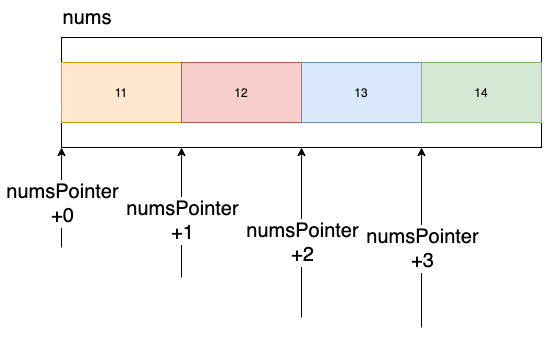
nums一个元素4字节,指针偏移1次4字节。所以这里可以通过从数组首地址开始偏移的方式进行取值操作。
同理对Class的内存结构我们是否也能进行内存平移来取值呢?
二、Class的结构内存计算
在Class的源码中我们发现核心的数据结构是这样的,暂时忽略其中的方法,因为不影响Class的内存结构。
方法都存在方法区
struct objc_class : objc_object { ...
// Class ISA; objc_object 中的 ISA Class superclass; cache_t cache; // formerly cache pointer and vtable class_data_bits_t bits; // class_rw_t * plus custom rr/alloc flags
...}| - | ISA | superClass | cache | bits |
|---|---|---|---|---|
| 说明 | ISA(结构体指针) | 父类(结构体指针) | 方法缓存 | 类的具体信息 |
| 大小(字节) | 8 | 8 | 16 | 8 |
三、objc_class: cache_t 的内存结构
我们忽略掉方法,剩下的核心数据结构如下
struct cache_t {private: explicit_atomic<uintptr_t> _bucketsAndMaybeMask; union { struct { explicit_atomic<mask_t> _maybeMask;#if __LP64__ uint16_t _flags;#endif uint16_t _occupied; }; explicit_atomic<preopt_cache_t *> _originalPreoptCache; };}3.1 小补充:LP64数据模型
在里面我们可以看到 __LP64__,这里代表的是LP64数据模型。现今所有64位的类Unix平台均使用LP64数据模型。
| TYPE | LP32 | ILP32 | LP64 | ILP64 | LLP64 |
|---|---|---|---|---|---|
| 含义 | 指long和pointer是32位的 | 指int,long和pointer是32位的 | 指long和pointer是64位 | 指int,long,pointer是64位 | 指long long和pointer是64位的 |
| CHAR | 8 | 8 | 8 | 8 | 8 |
| SHORT | 16 | 16 | 16 | 16 | 16 |
| INT | 16 | 32 | 32 | 64 | 32 |
| LONG | 32 | 32 | 64 | 64 | 32 |
| LONG LONG | 64 | 64 | 64 | 64 | 64 |
| POINTER | 32 | 32 | 64 | 64 | 64 |
3.2 内部联合体的内存结构
联合体包含了两部分:结构体、指针。我们已知arm64下指针占用8字节。我们来看下结构体需要占用多少
| - | _maybeMask | _flags |
|---|---|---|
| 类型 | uint32_t | uint16_t |
| 大小(字节) | 4 | 2 |
结构体大小 8 字节,联合体大小为8字节
3.3 结构总结
| - | _bucketsAndMaybeMask | union |
|---|---|---|
| 说明 | 指针(做什么的还需要研究) | 联合体 |
| 大小(字节) | long类型 8 | 8 |
cache_t大小为16字节
四、objc_class : class_data_bits_t 的内存结构
核心数据结构如下
struct class_data_bits_t { ... // Values are the FAST_ flags above. uintptr_t bits; ...}我们发现内部只有一个指针bits,那么如何通过它获取到类的详细信息呢?
我们发现这样一个函数,通过bits与上FAST_DATA_MASK可以获得class_rw_t。和我们找ISA的过程比较类似。
那么它是做什么的呢?
class_rw_t* data() const { return (class_rw_t *)(bits & FAST_DATA_MASK);}FAST_DATA_MASK在
LP64下的定义
#if __LP64__...// data pointer#define FAST_DATA_MASK 0x00007ffffffffff8UL五、class_data_bits_t : class_rw_t
rw: read-write
5.1 class_rw_t的内存结构
struct class_rw_t { // Be warned that Symbolication knows the layout of this structure. // 标志位,如是否是元类,是否实现了等 uint32_t flags; uint16_t witness;
explicit_atomic<uintptr_t> ro_or_rw_ext; //
Class firstSubclass; Class nextSiblingClass;
}5.2 一些重要函数
这里我们会看到一些眼熟的函数,在methods() properties() protocols()中我们发现了另一个重要的类型class_rw_ext_t
class_rw_ext_t *deepCopy(const class_ro_t *ro) { return extAlloc(ro, true);}
const method_array_t methods() const { auto v = get_ro_or_rwe(); if (v.is<class_rw_ext_t *>()) { return v.get<class_rw_ext_t *>(&ro_or_rw_ext)->methods; } else { return method_array_t{v.get<const class_ro_t *>(&ro_or_rw_ext)->baseMethods()}; }}
const property_array_t properties() const { ...}
const protocol_array_t protocols() const { ...}六、class_data_bits_t : class_rw_t : class_rw_ext_t
struct class_rw_ext_t { DECLARE_AUTHED_PTR_TEMPLATE(class_ro_t) class_ro_t_authed_ptr<const class_ro_t> ro;// 成员变量 method_array_t methods; property_array_t properties; protocol_array_t protocols; char *demangledName; uint32_t version;};6.1 list_array_tt
method_array_t/property_array_t/protocol_array_t 都是继承于 list_array_tt 的,通过泛型来完成不同的定义。
源码核心部分:
template <typename Element, typename List, template<typename> class Ptr>class list_array_tt { ... private: union { Ptr<List> list; uintptr_t arrayAndFlag; }; ...}- method_array_t
class method_array_t : public list_array_tt<method_t, method_list_t, method_list_t_authed_ptr> {...}- property_array_t
class property_array_t : public list_array_tt<property_t, property_list_t, RawPtr> {...}- protocol_array_t
class protocol_array_t : public list_array_tt<protocol_ref_t, protocol_list_t, RawPtr> {...}6.2 class_ro_t
源码核心部分:
struct class_ro_t { ... const ivar_list_t * ivars; // 成员变量 ...}七、LLDB调试Class内存结构
结构图
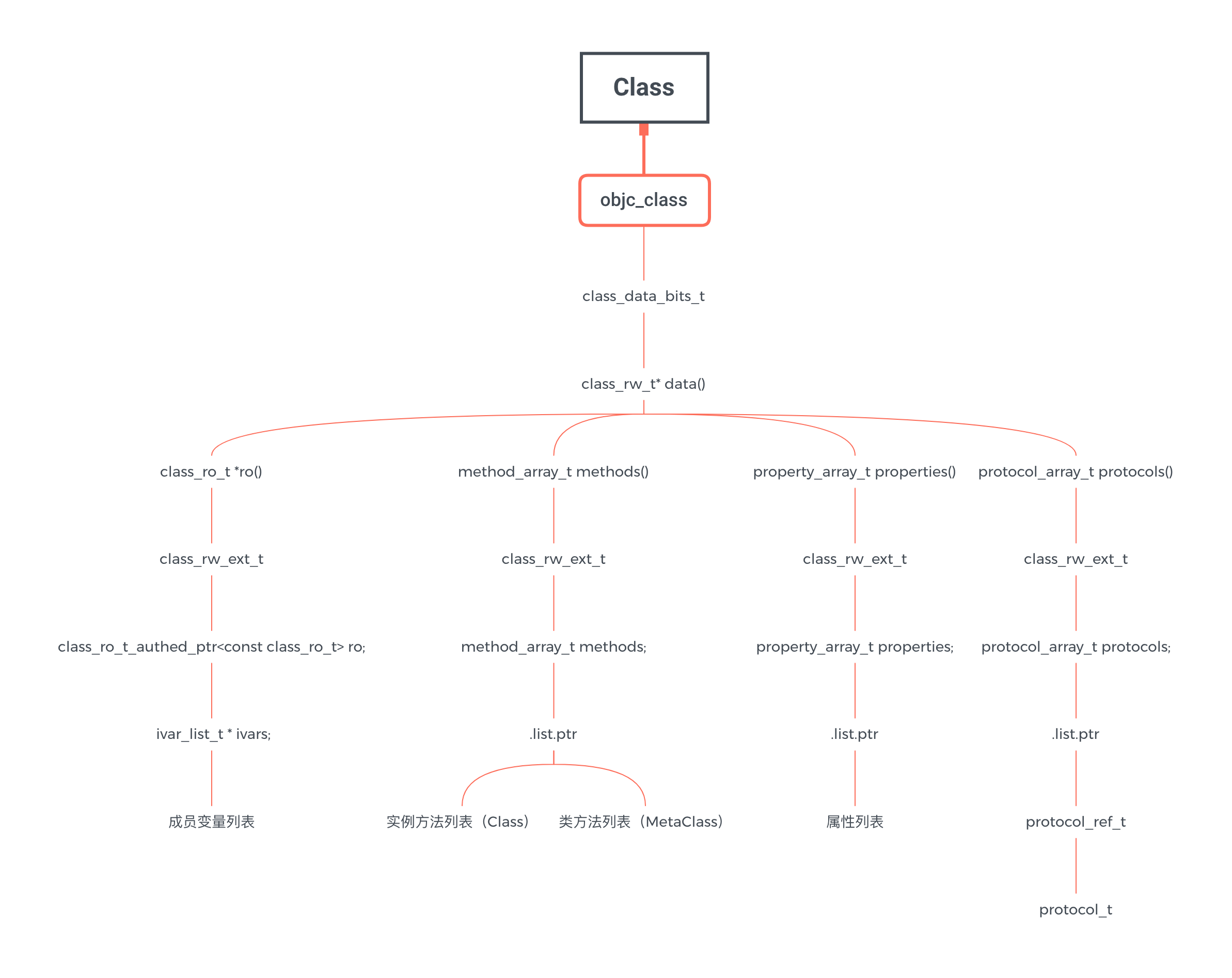
有这样的一个类
@interface RYModel : NSObject
@property (nonatomic, copy) NSString *name;@property (nonatomic, assign) NSInteger age;@property (nonatomic, assign) float height;@property (nonatomic, strong) RYModel *father;@property (nonatomic, assign) BOOL isBoy;
- (void)dosomething;
- (void)dosomethingWith:(NSString *)title;
+ (void)classDoSomething;
- (NSString *)sayMyName;
@end7.1 成员变量
获取
class_data_bits_t
这里通过内存偏移的方式找到class_data_bits_t,如前文所述:bits所在位置的偏移为8+8+16=32字节。
那么我们理论上可以通过对象地址+0x20计算出它的位置。
(lldb) p/x RYModel.class(Class) $0 = 0x00000001000083e0 RYModel
(lldb) x/4gx 0x00000001000083e00x1000083e0: 0x00000001000083b8 0x000000010036a1400x1000083f0: 0x000000010073c2d0 0x0004803400000007
// 计算bits(lldb) p/x 0x1000083e0 + 0x20(long) $1 = 0x0000000100008400
// 这里转换一下类型便于后面继续调试(lldb) p (class_data_bits_t *)0x0000000100008400(class_data_bits_t *) $2 = 0x0000000100008400通过
data()方法获取class_rw_t
(lldb) p (class_data_bits_t *)0x0000000100008400(class_data_bits_t *) $4 = 0x0000000100008400
(lldb) p $4->data()(class_rw_t *) $5 = 0x000000010073c040通过
properties获取属性列表容器
(lldb) p $5->properties(const property_array_t) $6 = { list_array_tt<property_t, property_list_t, RawPtr> = { = { list = { ptr = 0x0000000100008280 } arrayAndFlag = 4295000704 } }} Fix-it applied, fixed expression was: $5->properties()取出
list
(lldb) p $6.list(const RawPtr<property_list_t>) $7 = { ptr = 0x0000000100008280}取出
ptr
(lldb) p $7.ptr(property_list_t *const) $8 = 0x0000000100008280取出
ptr内的值
(lldb) p *$8(property_list_t) $9 = { entsize_list_tt<property_t, property_list_t, 0, PointerModifierNop> = (entsizeAndFlags = 16, count = 5)}通过下标取出
属性
(lldb) p $9.get(0)(property_t) $10 = (name = "name", attributes = "T@\"NSString\",C,N,V_name")(lldb) p $9.get(1)(property_t) $11 = (name = "age", attributes = "Tq,N,V_age")(lldb) p $9.get(2)(property_t) $12 = (name = "height", attributes = "Tf,N,V_height")(lldb) p $9.get(3)(property_t) $13 = (name = "father", attributes = "T@\"RYModel\",&,N,V_father")(lldb) p $9.get(4)(property_t) $14 = (name = "isBoy", attributes = "Tc,N,V_isBoy")7.2 实例方法列表
前面一些相似的步骤我们省略掉
从
class_rw_t -> methods获取方法列表容器
(lldb) p $5->methods(const method_array_t) $6 = { list_array_tt<method_t, method_list_t, method_list_t_authed_ptr> = { = { list = { ptr = 0x00000001000080e8 } arrayAndFlag = 4295000296 } }} Fix-it applied, fixed expression was: $5->methods()取出
list
(lldb) p $6.list(const method_list_t_authed_ptr<method_list_t>) $14 = { ptr = 0x00000001000080e8}取出
ptr
(lldb) p $14.ptr(method_list_t *const) $15 = 0x00000001000080e8取出
ptr中的数据method_list_t
(lldb) p *$15(method_list_t) $16 = { entsize_list_tt<method_t, method_list_t, 4294901763, method_t::pointer_modifier> = (entsizeAndFlags = 27, count = 14)}获取方法数量
(lldb) p $16.count(uint32_t) $29 = 14通过c++函数
get()与big()单个获取类的实例方法这里除了我们自己定义的一些实例方法,还看到了一些列属性自动生成的
set、get方法,以及析构函数
(lldb) p $16.get(0).big()(method_t::big) $19 = { name = "setFather:" types = 0x0000000100003f60 "v24@0:8@16" imp = 0x0000000100003cc0 (ObjcBuild`-[RYModel setFather:])}(lldb) p $16.get(1).big()(method_t::big) $20 = { name = "father" types = 0x0000000100003f6b "@16@0:8" imp = 0x0000000100003ca0 (ObjcBuild`-[RYModel father])}
... // 省略一些Set、get
(lldb) p $16.get(3).big()(method_t::big) $22 = { name = "dosomething" types = 0x0000000100003f3b "v16@0:8" imp = 0x0000000100003b30 (ObjcBuild`-[RYModel dosomething])}(lldb) p $16.get(4).big()(method_t::big) $23 = { name = "dosomethingWith:" types = 0x0000000100003f60 "v24@0:8@16" imp = 0x0000000100003b40 (ObjcBuild`-[RYModel dosomethingWith:])}
...
(lldb) p $16.get(8).big()(method_t::big) $27 = { name = ".cxx_destruct" types = 0x0000000100003f3b "v16@0:8" imp = 0x0000000100003d30 (ObjcBuild`-[RYModel .cxx_destruct])}
... // 省略一些Set、get7.3 协议列表
前面一些相似的步骤我们省略掉
从
class_rw_t -> protocols获取协议列表容器
(lldb) p $2->protocols()(const protocol_array_t) $3 = { list_array_tt<unsigned long, protocol_list_t, RawPtr> = { = { list = { ptr = 0x00000001000083b8 } arrayAndFlag = 4295001016 } }}取出
list
(lldb) p $3.list(const RawPtr<protocol_list_t>) $4 = { ptr = 0x00000001000083b8}取出
ptr
(lldb) p $4.ptr(protocol_list_t *const) $5 = 0x00000001000083b8取出
ptr中的数据protocol_list_t
(lldb) p *$5(protocol_list_t) $6 = (count = 1, list = protocol_ref_t [] @ 0x00007f9a62cb8778)这里可以发现,里面的list中存了一个指针,并不是完整的一个数据结构。我们找到了这样的定义:
typedef uintptr_t protocol_ref_t; // protocol_t *, but unremapped
获取
protocol_t *
(lldb) p (protocol_t *)$6.list[0](protocol_t *) $7 = 0x00000001000088a0读取数据
(lldb) p *$7(protocol_t) $8 = { objc_object = { isa = { bits = 4298547400 cls = Protocol = { nonpointer = 0 has_assoc = 0 has_cxx_dtor = 0 shiftcls = 537318425 magic = 0 weakly_referenced = 0 unused = 0 has_sidetable_rc = 0 extra_rc = 0 } } } mangledName = 0x0000000100003e71 "RYProtocol" protocols = 0x0000000100008310 instanceMethods = 0x0000000100008328 classMethods = nil optionalInstanceMethods = nil optionalClassMethods = nil instanceProperties = nil size = 96 flags = 0 _extendedMethodTypes = 0x0000000100008348 _demangledName = 0x0000000000000000 _classProperties = nil}7.4 成员变量
前面一些相似的步骤我们省略掉
从
class_rw_t -> ro()获取成员变量列表容器
(lldb) p $4->ro()(const class_ro_t *) $18 = 0x00000001000083d0
class_ro_t -> ivars获取成员变量列表
(lldb) p $18->ivars(const ivar_list_t *const) $19 = 0x0000000100008570
(lldb) p *$19(const ivar_list_t) $20 = { entsize_list_tt<ivar_t, ivar_list_t, 0, PointerModifierNop> = (entsizeAndFlags = 32, count = 5)}从成员变量列表中获取成员变量
(lldb) p $20.count(const uint32_t) $21 = 5
(lldb) p $20.get(0)(ivar_t) $22 = { offset = 0x0000000100008770 name = 0x0000000100003de7 "_isBoy" type = 0x0000000100003f47 "c" alignment_raw = 0 size = 1}(lldb) p $20.get(1)(ivar_t) $23 = { offset = 0x0000000100008778 name = 0x0000000100003dee "_height" type = 0x0000000100003f49 "f" alignment_raw = 2 size = 4}(lldb) p $20.get(2)(ivar_t) $24 = { offset = 0x0000000100008780 name = 0x0000000100003df6 "_name" type = 0x0000000100003f4b "@\"NSString\"" alignment_raw = 3 size = 8}(lldb) p $20.get(3)(ivar_t) $25 = { offset = 0x0000000100008788 name = 0x0000000100003dfc "_age" type = 0x0000000100003f57 "q" alignment_raw = 3 size = 8}(lldb) p $20.get(4)(ivar_t) $26 = { offset = 0x0000000100008790 name = 0x0000000100003e01 "_father" type = 0x0000000100003f59 "@\"RYModel\"" alignment_raw = 3 size = 8}7.5 类方法
类方法我们需要到元类中进行查找
获取元类类信息
(lldb) p/x RYModel.class(Class) $67 = 0x00000001000087c0 RYModel(lldb) x/4gx 0x00000001000087c00x1000087c0: 0x0000000100008798 0x000000010036a1400x1000087d0: 0x00000001010695c0 0x0004803400000007(lldb) p/x 0x0000000100008798 & 0x00007ffffffffff8ULL(unsigned long long) $68 = 0x0000000100008798(lldb) p 0x0000000100008798 + 0x20(long) $70 = 4295002040(lldb) p/x 0x0000000100008798 + 0x20(long) $71 = 0x00000001000087b8(lldb) p (class_data_bits_t *)0x00000001000087b8(class_data_bits_t *) $72 = 0x00000001000087b8
(lldb) p $72->data()(class_rw_t *) $73 = 0x0000000101069510(lldb) p $73->methods()(const method_array_t) $74 = { list_array_tt<method_t, method_list_t, method_list_t_authed_ptr> = { = { list = { ptr = 0x0000000100008398 } arrayAndFlag = 4295000984 } }}获取元类方法列表(类方法)
(lldb) p $74.list(const method_list_t_authed_ptr<method_list_t>) $75 = { ptr = 0x0000000100008398}(lldb) p $75.ptr(method_list_t *const) $76 = 0x0000000100008398(lldb) p *$76(method_list_t) $77 = { entsize_list_tt<method_t, method_list_t, 4294901763, method_t::pointer_modifier> = (entsizeAndFlags = 27, count = 1)}输出方法信息
(lldb) p $77.get(0).big()(method_t::big) $78 = { name = "classDoSomething" types = 0x0000000100003f3f "v16@0:8" imp = 0x0000000100003920 (ObjcBuild`+[RYModel classDoSomething])}