

Class之cache_t
之前进行类的结构的分析的时候,我们还有一个重要的东西没有进行研究,就是 cache_t。
一、cache_t 的基本结构
和之前一样,我们在源码环境下编译调试。
回顾一下class的基础结构:
| - | ISA | superClass | cache | bits |
|---|---|---|---|---|
| 说明 | ISA(结构体指针) | 父类(结构体指针) | 方法缓存 | 类的具体信息 |
| 大小(字节) | 8 | 8 | 16 | 8 |
1.1 源码
其核心数据结构如下
struct cache_t {
// <<<< 主要数据结构private: explicit_atomic<uintptr_t> _bucketsAndMaybeMask; union { struct { explicit_atomic<mask_t> _maybeMask;#if __LP64__ uint16_t _flags;#endif uint16_t _occupied; }; explicit_atomic<preopt_cache_t *> _originalPreoptCache; }; ...};- _bucketsAndMaybeMask
- _bucketsAndMaybeMask is a buckets_t pointer
- 它是一个
buckets_t类型的指针
- _maybeMask
- _maybeMask is the buckets mask
- _occupied
- _originalPreoptCache
1.2 LLDB调试
(lldb) p/x RYModel.class(Class) $10 = 0x00000001000087c8 RYModel
// 平移取 cache(lldb) p (cache_t *)(0x00000001000087c8 + 0x10)(cache_t *) $11 = 0x00000001000087d8(lldb) p $11(cache_t *) $11 = 0x00000001000087d8
// 取出 cache 内容(lldb) p *$11(cache_t) $12 = { _bucketsAndMaybeMask = { std::__1::atomic<unsigned long> = { Value = 4314911728 } } = { = { _maybeMask = { std::__1::atomic<unsigned int> = { Value = 3 } } _flags = 32820 _occupied = 1 } _originalPreoptCache = { std::__1::atomic<preopt_cache_t *> = { Value = 0x0001803400000003 } } }}我们无法直接输出相关成员内容了,为了继续输出相关属性我们继续看源码
相关get方法
public: // The following four fields are public for objcdt's use only. // objcdt reaches into fields while the process is suspended // hence doesn't care for locks and pesky little details like this // and can safely use these. unsigned capacity() const;// 容量 struct bucket_t *buckets() const; Class cls() const;
#if CONFIG_USE_PREOPT_CACHES const preopt_cache_t *preopt_cache() const;#endif
mask_t occupied() const;// 缓存数量我们使用 buckets() 方法继续输出调试
(lldb) p $12.buckets()[0](bucket_t) $13 = { _sel = { std::__1::atomic<objc_selector *> = (null) { Value = nil } } _imp = { std::__1::atomic<unsigned long> = { Value = 0 } }}(lldb) p $12.buckets()[1](bucket_t) $14 = { _sel = { std::__1::atomic<objc_selector *> = (null) { Value = nil } } _imp = { std::__1::atomic<unsigned long> = { Value = 0 } }}(lldb) p $12.buckets()[2](bucket_t) $15 = { _sel = { std::__1::atomic<objc_selector *> = "" { Value = "" } } _imp = { std::__1::atomic<unsigned long> = { Value = 48856 } }}(lldb) p $15.sel()(SEL) $16 = "dosomething"
(lldb) p $15.imp(nil, RYModel.class)(IMP) $17 = 0x0000000100003910 (KCObjcBuild`-[RYModel dosomething])(lldb)这里你会发现用到了 $12.buckets()[2] 的下标是2,0和1都是空的。因为这里 buckets 不是数组,是哈希表的结构。
1.3、bucket_t的数据结构
包含了 SEL 和 IMP
struct bucket_t {private: // IMP-first is better for arm64e ptrauth and no worse for arm64. // SEL-first is better for armv7* and i386 and x86_64.#if __arm64__ explicit_atomic<uintptr_t> _imp; explicit_atomic<SEL> _sel;#else explicit_atomic<SEL> _sel; explicit_atomic<uintptr_t> _imp;#endif...};二、自己实现 cache_t 数据结构
使用LLDB进行调试感觉到太麻烦了,为了更方便的进行调试我们尝试对数据结构进行模仿。
#import <objc/runtime.h>
typedef uint32_t mask_t; // x86_64 & arm64 asm are less efficient with 16-bits
struct lw_bucket_t { SEL _sel; IMP _imp;};struct lw_cache_t { struct lw_bucket_t *_bukets; mask_t _maybeMask; uint16_t _flags; uint16_t _occupied;};
struct lw_class_data_bits_t { uintptr_t bits;};
// cache classstruct lw_objc_class { Class isa; Class superclass; struct lw_cache_t cache; struct lw_class_data_bits_t bits;};2.1 调试代码
RYModel *obj = [RYModel alloc];[obj dosomethingA];[obj dosomethingB];struct lw_objc_class *lw_class = (__bridge struct lw_objc_class *)(RYModel.class);NSLog(@"缓存数量:%hu - 容量:%u",lw_class->cache._occupied,lw_class->cache._maybeMask);
for (mask_t i = 0; i<lw_class->cache._maybeMask; i++) { struct lw_bucket_t bucket = lw_class->cache._bukets[i]; NSLog(@"SEL:%@ - IMP:%pf",NSStringFromSelector(bucket._sel),bucket._imp);}输出:
-[RYModel dosomethingA]-[RYModel dosomethingB]缓存数量:2 - 容量:3SEL:dosomethingA - IMP:0xb300fSEL:dosomethingB - IMP:0xb330fEL:(null) - IMP:0x0f2.2 扩容
我们调整一下代码
[obj dosomethingA];[obj dosomethingB];[obj dosomethingC];
输出:2021-06-27 16:00:51.939958+0800 LWCacheT[73396:867351] -[RYModel dosomethingA]2021-06-27 16:00:51.940352+0800 LWCacheT[73396:867351] -[RYModel dosomethingB]2021-06-27 16:00:51.940441+0800 LWCacheT[73396:867351] -[RYModel dosomethingC]2021-06-27 16:00:51.940602+0800 LWCacheT[73396:867351] 缓存数量:1 - 容量:72021-06-27 16:00:51.940668+0800 LWCacheT[73396:867351] SEL:(null) - IMP:0x0f2021-06-27 16:00:51.940742+0800 LWCacheT[73396:867351] SEL:(null) - IMP:0x0f2021-06-27 16:00:51.940780+0800 LWCacheT[73396:867351] SEL:(null) - IMP:0x0f2021-06-27 16:00:51.940814+0800 LWCacheT[73396:867351] SEL:(null) - IMP:0x0f2021-06-27 16:00:51.940900+0800 LWCacheT[73396:867351] SEL:(null) - IMP:0x0f2021-06-27 16:00:51.941025+0800 LWCacheT[73396:867351] SEL:(null) - IMP:0x0f2021-06-27 16:00:51.941124+0800 LWCacheT[73396:867351] SEL:dosomethingC - IMP:0xbcd8f我们发现这里进行了扩容。这里又是什么逻辑呢?
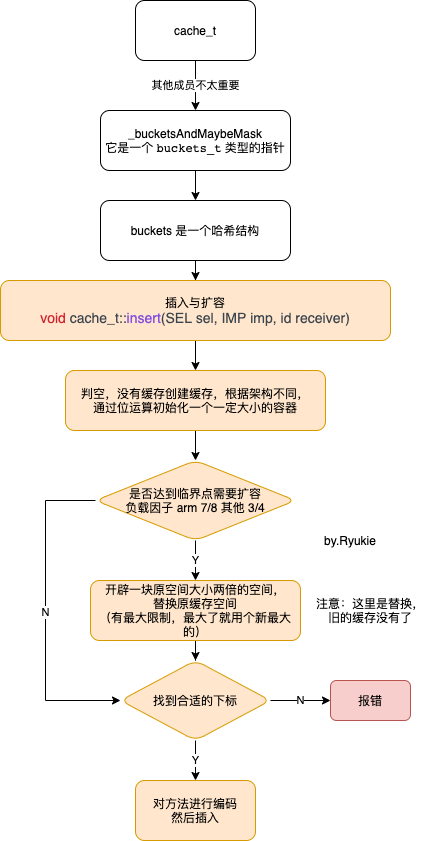
三、insert 与扩容
为了更好的理解扩容,我们先了解一下方法缓存是怎么插入的。
3.1 核心源码解读
void cache_t::insert(SEL sel, IMP imp, id receiver){
...
// Use the cache as-is if until we exceed our expected fill ratio. // 计数 + 1 mask_t newOccupied = occupied() + 1; unsigned oldCapacity = capacity(), capacity = oldCapacity; if (slowpath(isConstantEmptyCache())) { // 判空,没有缓存创建缓存,根据架构不同,通过位运算初始化一个一定大小的容器 // Cache is read-only. Replace it. if (!capacity) capacity = INIT_CACHE_SIZE; reallocate(oldCapacity, capacity, /* freeOld */false); } else if (fastpath(newOccupied + CACHE_END_MARKER <= cache_fill_ratio(capacity))) { // Cache is less than 3/4 or 7/8 full. Use it as-is. // 未达到扩容临界点 }#if CACHE_ALLOW_FULL_UTILIZATION else if (capacity <= FULL_UTILIZATION_CACHE_SIZE && newOccupied + CACHE_END_MARKER <= capacity) { // Allow 100% cache utilization for small buckets. Use it as-is.
// Allow 100% cache utilization for smaller cache sizes. This has the same // advantages and disadvantages as the fill ratio. A very large percentage // of caches end up with very few entries and the worst case of collision // chains in small tables is relatively small. // NOTE: objc_msgSend properly handles a cache lookup with a full cache.
// }#endif else { // 扩容操作 capacity = capacity ? capacity * 2 : INIT_CACHE_SIZE; if (capacity > MAX_CACHE_SIZE) { capacity = MAX_CACHE_SIZE; } reallocate(oldCapacity, capacity, true); }
bucket_t *b = buckets(); mask_t m = capacity - 1; mask_t begin = cache_hash(sel, m); mask_t i = begin;
// Scan for the first unused slot and insert there. // There is guaranteed to be an empty slot. // 循环找到合适的下标 do { if (fastpath(b[i].sel() == 0)) { incrementOccupied(); /// 插入逻辑 b[i].set<Atomic, Encoded>(b, sel, imp, cls()); return; } if (b[i].sel() == sel) { // The entry was added to the cache by some other thread // before we grabbed the cacheUpdateLock. return; } } while (fastpath((i = cache_next(i, m)) != begin));
// 未找到合适的下标 crash bad_cache(receiver, (SEL)sel);#endif // !DEBUG_TASK_THREADS}a. INIT_CACHE_SIZE 初始化缓存
通过源码发现,这里是通过位运算进行的缓存空间大小初始化。
如,当前我们的是 1 << 2 = 4。同时我们还能发现最大值为 1 << 16。
/* Initial cache bucket count. INIT_CACHE_SIZE must be a power of two. */enum {#if CACHE_END_MARKER || (__arm64__ && !__LP64__) // When we have a cache end marker it fills a bucket slot, so having a // initial cache size of 2 buckets would not be efficient when one of the // slots is always filled with the end marker. So start with a cache size // 4 buckets. INIT_CACHE_SIZE_LOG2 = 2,#else // Allow an initial bucket size of 2 buckets, since a large number of // classes, especially metaclasses, have very few imps, and we support // the ability to fill 100% of the cache before resizing. INIT_CACHE_SIZE_LOG2 = 1,#endif INIT_CACHE_SIZE = (1 << INIT_CACHE_SIZE_LOG2), MAX_CACHE_SIZE_LOG2 = 16, MAX_CACHE_SIZE = (1 << MAX_CACHE_SIZE_LOG2), FULL_UTILIZATION_CACHE_SIZE_LOG2 = 3, FULL_UTILIZATION_CACHE_SIZE = (1 << FULL_UTILIZATION_CACHE_SIZE_LOG2),};b. 扩容临界点
newOccupied + CACHE_END_MARKER <= cache_fill_ratio(capacity)
// Cache is less than 3/4 or 7/8 full. Use it as-is.
真机为 7/8
// objc_msgSend has few registers available.// Cache scan increments and wraps at special end-marking bucket.#define CACHE_END_MARKER 1
// Historical fill ratio of 75% (since the new objc runtime was introduced).static inline mask_t cache_fill_ratio(mask_t capacity) { return capacity * 3 / 4;}
#elif __arm64__ && !__LP64__#define CACHE_END_MARKER 0
// Historical fill ratio of 75% (since the new objc runtime was introduced).static inline mask_t cache_fill_ratio(mask_t capacity) { return capacity * 3 / 4;}
#elif __arm64__ && __LP64__
// objc_msgSend has lots of registers available.// Cache scan decrements. No end marker needed.#define CACHE_END_MARKER 0
// Allow 87.5% fill ratio in the fast path for all cache sizes.// Increasing the cache fill ratio reduces the fragmentation and wasted space// in imp-caches at the cost of potentially increasing the average lookup of// a selector in imp-caches by increasing collision chains. Another potential// change is that cache table resizes / resets happen at different moments.static inline mask_t cache_fill_ratio(mask_t capacity) { return capacity * 7 / 8;}c. 扩容操作
扩容按
x2进行扩容
capacity = capacity ? capacity * 2 : INIT_CACHE_SIZE;if (capacity > MAX_CACHE_SIZE) { capacity = MAX_CACHE_SIZE;}reallocate(oldCapacity, capacity, true);d. 扩容后
我们看一下触发扩容的那次Log:
2021-06-27 16:00:51.940602+0800 LWCacheT[73396:867351] 缓存数量:1 - 容量:72021-06-27 16:00:51.940668+0800 LWCacheT[73396:867351] SEL:(null) - IMP:0x0f2021-06-27 16:00:51.940742+0800 LWCacheT[73396:867351] SEL:(null) - IMP:0x0f2021-06-27 16:00:51.940780+0800 LWCacheT[73396:867351] SEL:(null) - IMP:0x0f2021-06-27 16:00:51.940814+0800 LWCacheT[73396:867351] SEL:(null) - IMP:0x0f2021-06-27 16:00:51.940900+0800 LWCacheT[73396:867351] SEL:(null) - IMP:0x0f2021-06-27 16:00:51.941025+0800 LWCacheT[73396:867351] SEL:(null) - IMP:0x0f2021-06-27 16:00:51.941124+0800 LWCacheT[73396:867351] SEL:dosomethingC - IMP:0xbcd8f这次扩容后,我们发现。除了最新的,之前的缓存都没有了。
这是因为 扩容 并不是真正意义上的扩展之前的空间,而是重新开辟一块空间。
3.2 cache_hash 计算哈希下标
static inline mask_t cache_hash(SEL sel, mask_t mask){ uintptr_t value = (uintptr_t)sel;#if CONFIG_USE_PREOPT_CACHES value ^= value >> 7;// 真机 & m1#endif return (mask_t)(value & mask);}3.3 cache_next 寻找插入位置
#if CACHE_END_MARKERstatic inline mask_t cache_next(mask_t i, mask_t mask) { return (i+1) & mask; // 向后找}#elif __arm64__static inline mask_t cache_next(mask_t i, mask_t mask) { return i ? i-1 : mask; // 反复横跳}#else#error unexpected configuration#endif3.4 set 差入逻辑
template<Atomicity atomicity, IMPEncoding impEncoding>void bucket_t::set(bucket_t *base, SEL newSel, IMP newImp, Class cls){... // objc_msgSend uses sel and imp with no locks. // It is safe for objc_msgSend to see new imp but NULL sel // (It will get a cache miss but not dispatch to the wrong place.) // It is unsafe for objc_msgSend to see old imp and new sel. // Therefore we write new imp, wait a lot, then write new sel.
/// 对 IMP 进行编码操作 uintptr_t newIMP = (impEncoding == Encoded ? encodeImp(base, newImp, newSel, cls) : (uintptr_t)newImp);... 保存}将方法插入缓存,并不是直接插入的。而是进行了编码。(uintptr_t)newImp ^ (uintptr_t)cls;
3.5 流程图
关于类型转换的思考
这里使用自己定义的类型进行转换,感觉是不是很懵,感觉这也行?
我们抛开代码,思考一下:我们为什么要定义各种数据结构?为了能读写数据。
而能正确读写数据的前提是,计算机能认识这些数据。而我们定义的数据结构,就是计算机认识他们的基准。
只要两个数据结构的内存结构一致,那么进行转换就没有问题。